A neglected infection in Europe
by Dr Adriana Anita and Dr Antonio Rivero-Juarez
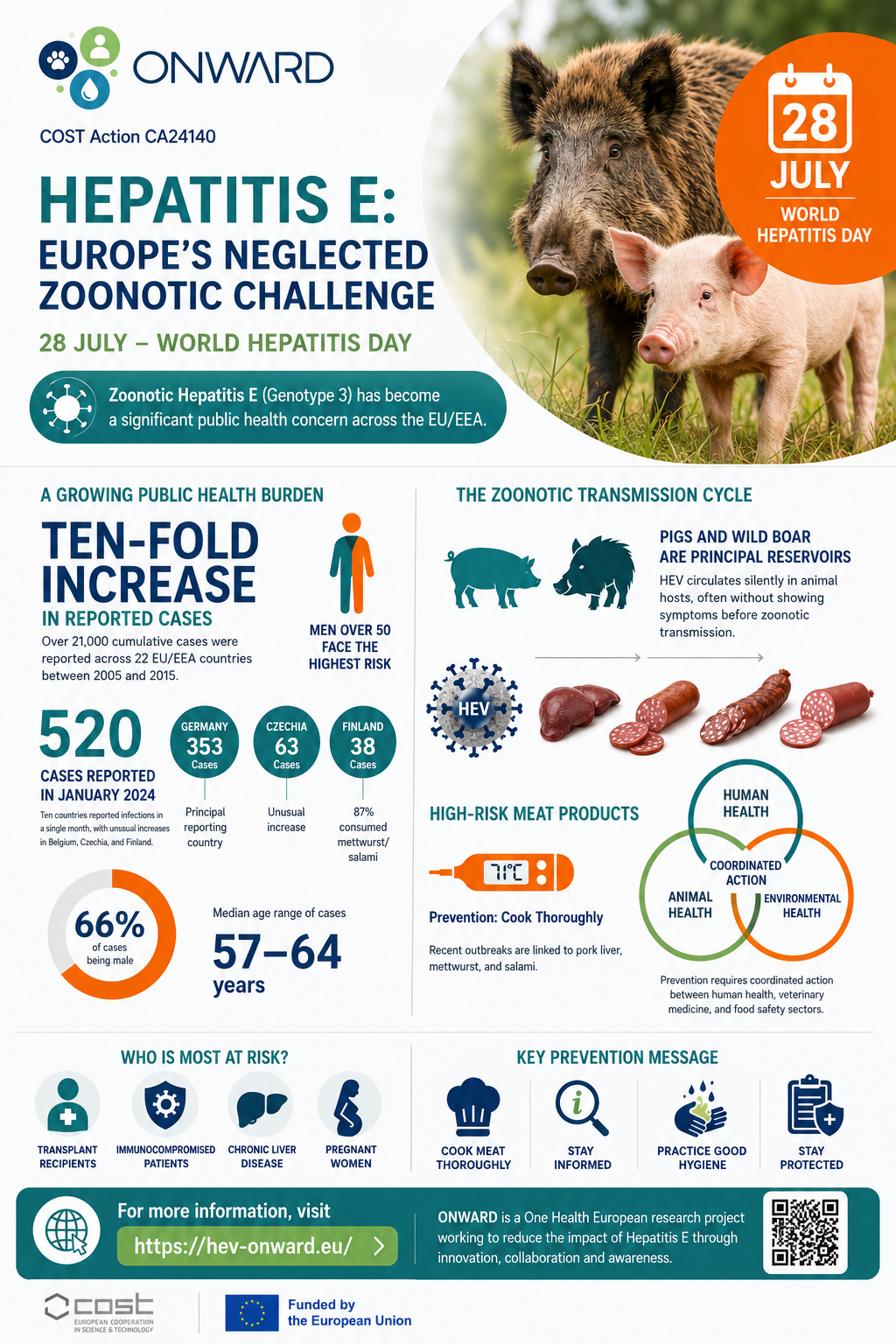
Hepatitis E virus (HEV) is a major cause of acute viral hepatitis worldwide. The World Health Organization estimates that around 20 million HEV infections occur every year. Although the global burden is driven largely by waterborne transmission of genotypes 1 and 2, the European epidemiology is different: most indigenous cases are associated with zoonotic HEV, particularly genotype 3.[1]
Between 2005 and 2015, more than 21,000 cases were reported across 22 EU/EEA countries, with a ten-fold increase in annual notifications. This trend should be interpreted carefully: increased clinical awareness and testing contributed to the rise, while differences in surveillance mean that the true burden remains uncertain.[2]
The central message is therefore not that Europe is facing a sudden, uniform “surge”, but that an established zoonotic infection has been underestimated. HEV should be considered in patients with compatible hepatitis regardless of travel history.
Why hepatitis E matters
Many HEV infections are asymptomatic or self-limiting. However, acute infection can be severe in people with pre-existing chronic liver disease, and persistent infection can occur in solid-organ transplant recipients and other immunosuppressed patients. Neurological, renal and other extrahepatic manifestations are also recognised. The particularly high mortality reported during pregnancy relates mainly to genotype 1 and 2 settings and should not be communicated without this epidemiological context.[1]
In Europe, domestic pigs and wild boar are important hosts for zoonotic HEV. Infection can follow consumption of raw or insufficiently cooked pork, wild-boar meat and liver-containing products.[3] Specific outbreaks have occasionally been linked to particular products, but prevention messages should address food preparation and the food chain as a whole rather than stigmatise a single food, producer or culinary tradition.
Foodborne transmission is only part of the picture. Blood safety, occupational exposure and environmental pathways also require proportionate attention. In parallel, Rocahepevirus ratti (ratHEV) has emerged as a distinct zoonotic hepevirus capable of infecting humans. It should be studied and communicated separately from conventional HEV genotypes rather than grouped indiscriminately with them.[4]
The implementation gap
Europe has strong expertise in clinical medicine, veterinary health, food safety and environmental science, but these capacities are not yet consistently connected. Progress is limited by:
- variable clinical awareness and access to appropriate serological and molecular testing;
- heterogeneous case definitions, reporting practices and surveillance intensity across countries;
- limited integration of human, animal, food and environmental data;
- important knowledge gaps on transmission pathways, viral inactivation and the burden of disease; and
- public communication that can alternate between neglecting HEV and oversimplifying its risks.
ONWARD’s five commitments
- Diagnose better. Promote timely HEV testing in unexplained acute hepatitis and appropriate testing in immunosuppressed patients, independent of travel history. Support harmonised, quality-assured serological and molecular methods.
- Care better. Improve recognition of severe, chronic and extrahepatic disease and strengthen evidence-based pathways for follow-up, referral and treatment of vulnerable patients.
- Prevent better. Translate evidence into proportionate measures across food safety, animal health, occupational health, blood safety and environmental management. For consumers, the message is simple: avoid raw or insufficiently cooked pork, wild-boar meat and liver products, particularly when vulnerable, and follow national food-safety guidance [3,5].
- Communicate better. Provide clear, consistent and evidence-based information. Communication should explain uncertainty, distinguish between HEV genotypes and ratHEV, and avoid alarmist language or blame directed at individual foods, sectors or communities.
- Connect better. Build sustained collaboration between clinicians, laboratories, public-health authorities, veterinarians, food and environmental scientists, policymakers, patient organisations and affected industries. Shared standards and interoperable data are essential for effective One Health surveillance.
From awareness to action
Awareness is valuable only when it changes practice. ONWARD calls on each community to take a concrete next step:
| WHO | WHAT SHOULD CHANGE |
| Citizens | Cook pork, wild-boar meat and liver products thoroughly; practise good kitchen hygiene; seek medical advice when clinically indicated. |
| Clinicians | Consider HEV in compatible hepatitis even without travel history, and recognise patients at risk of severe or persistent infection. |
| Laboratories | Use quality-assured assays, participate in external quality assessment and support comparable molecular surveillance. |
| Public-health authorities | Strengthen and harmonise surveillance, clarify testing and reporting pathways, and connect human data with relevant One Health evidence. |
| Veterinary and food sectors | Support risk-based monitoring, research and control across animals, production and processing without attributing risk to a single product category. |
| Researchers and funders | Prioritise multicountry studies, standardised methods, data sharing and research that can be translated into prevention and policy. |
A One Health call to Europe
Hepatitis E sits at the intersection of human health, animal health, food systems and the environment. No single discipline can define or reduce its burden alone. Europe now has an opportunity to move from fragmented awareness towards coordinated diagnosis, surveillance and prevention.
ONWARD calls for a European response that is scientifically rigorous, proportionate to the evidence and designed to produce measurable improvements. The objective is not to create alarm, but to ensure that preventable infections are prevented, vulnerable patients are recognised and managed promptly, and emerging threats are identified before they become established public-health problems.

Selected sources
- World Health Organization. Hepatitis E. Fact sheet. Updated 26 June 2026. https://www.who.int/news-room/fact-sheets/detail/hepatitis-e
- European Centre for Disease Prevention and Control. Hepatitis E in the EU/EEA, 2005–2015. https://www.ecdc.europa.eu/en/news-events/ecdc-report-10-fold-increase-hepatitis-e-cases-eueea-between-2005-and-2015
- European Food Safety Authority. Public health risks associated with hepatitis E virus as a food-borne pathogen. EFSA Journal. 2017;15(7):4886. https://doi.org/10.2903/j.efsa.2017.4886
- Rivero-Juarez A, Johne R, Sridhar S. Rocahepevirus ratti: molecular evolution, zoonotic potential and public health impact. Nature Communications. 2026;17:4853. https://doi.org/10.1038/s41467-026-71382-3
- Robert Koch Institute. Hepatitis E: RKI-Ratgeber. https://www.rki.de/DE/Aktuelles/Publikationen/RKI-Ratgeber/Ratgeber/Ratgeber_HepatitisE.html
- Johne R, et al. Hepatitis E virus in meat and meat products without liver contents—Detection methods, occurrence and implications for public health. International Journal of Food Microbiology. 2026;460:111971. https://doi.org/10.1016/j.ijfoodmicro.2026.111971
- Campbell R, et al. Environmental considerations in hepatitis E virus transmission: Is there a missing link? World Journal of Hepatology. 2026;18(2):112467.